Where to run abliterated (uncensored) LLMs: GPU marketplaces, APIs and clouds compared
We compared the terms, sign-up and payment docs of Vast.ai, Runpod, TensorDock, SaladCloud, Akash, io.net and Hyperbolic on 16 November 2026. What each says about content, what it asks you to prove about yourself, and why a Lium pod suits abliterated models: no e-mail needed to sign up, crypto top-ups, root on the GPUs and 288 GB of GPU memory for $2.40 per hour.
Lium team8 min read
abliterated
uncensored
llm-inference
self-hosting
buyer-guide
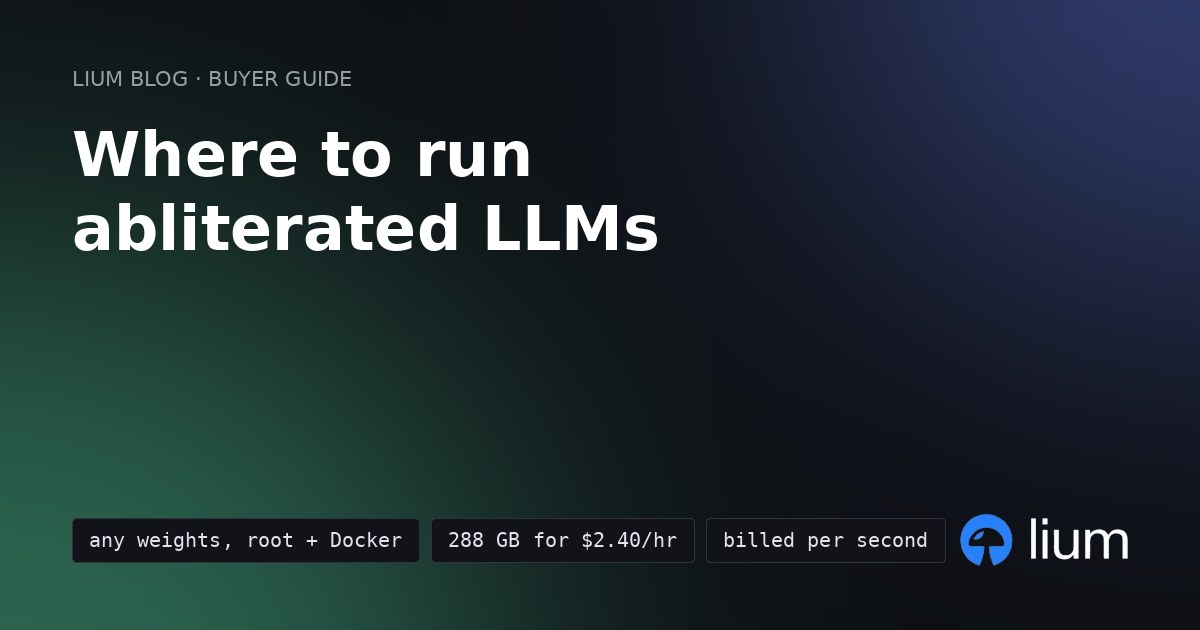
An abliterated model is an open-weights LLM with its refusal behaviour edited out of the weights. You can't get one from most model APIs, because those APIs serve only the models they choose to host. To use one, you serve it yourself on GPUs you rent. This post compares where you can do that: GPU marketplaces like Lium, Vast.ai, Runpod, TensorDock, SaladCloud, Akash, io.net and Hyperbolic, then hosted APIs, managed endpoints and hyperscalers.
What matters when you run an abliterated model
- Who can see your prompts. A model running on a GPU you rent keeps prompts and answers on that machine, but downloads, cloud fallbacks, agent tools, logs and an exposed API each add their own path out. This 2026 data-flow guide recommends to "bind locally by default, authenticate remote access, and set log/backup retention deliberately".
- What the provider's terms allow. Some terms ban broad content categories, or reserve the right to monitor what you run. Those clauses decide whether a provider is a fit, so we quote them below.
- What you have to hand over to sign up. E-mail, card, ID, or nothing.
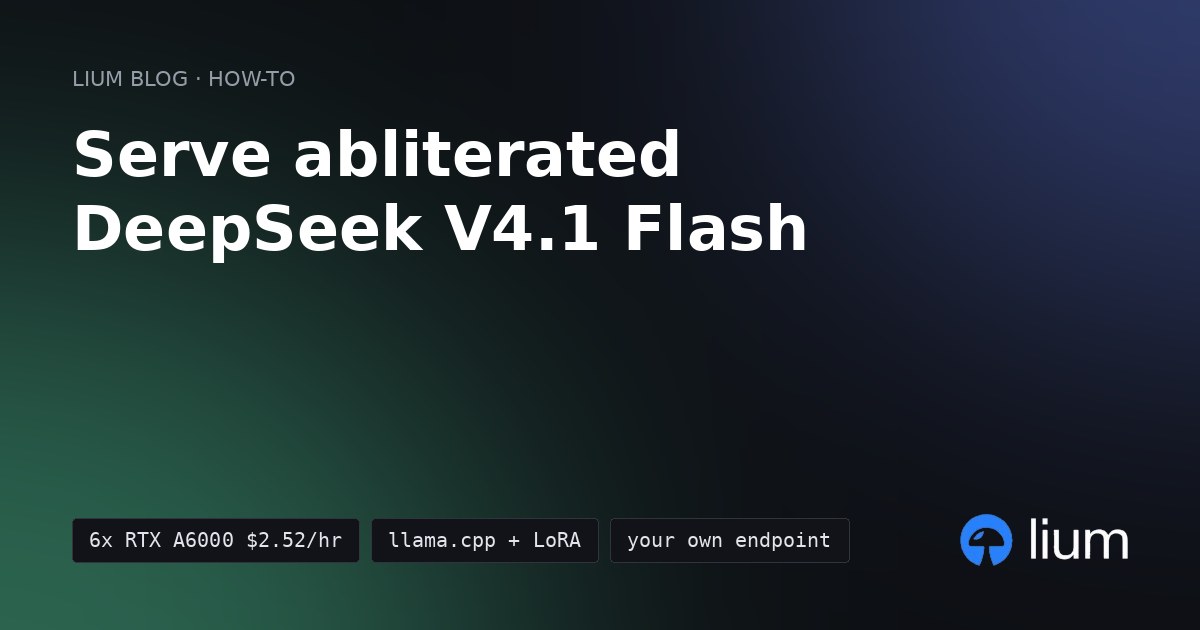
- Enough GPU memory. Abliteration does not shrink a model. The abliterated DeepSeek V4.1 Flash needs about 300 GB even at 2 bits, so a provider has to offer multi-GPU nodes with large cards.
- Root on the machine. You need to build the server and load the exact weights and adapters you chose.
Why Lium suits it
- No e-mail needed. Lium can create an account with no e-mail or password: you get a random 32-character fingerprint as your login. Use an e-mail if you want password resets and receipts.
- Card or crypto. You top up by card or crypto, and the billing docs list no identity check for a crypto top-up. Pay from a wallet you control.
- Short terms. Lium's Terms of Service (effective 23 October 2026) ban illegal workloads, rights infringement and network attacks. They have no clause on content categories.
- Providers may not look. Lium's workload privacy rule permanently bans any provider who accesses, inspects, copies or interferes with a renter's workload.
- Root and Docker on every pod, with no model catalog or allow-list between you and the weights.
- Big GPUs, low prices. The pricing feed listed 100 GPU models on 16 November 2026 at 11:45 UTC, from RTX cards to B300 and GB300. Six RTX A6000s (288 GB) cost $2.40 per hour on Lium Secure, billed per second.
What "abliterated" means
Abliteration finds the directions in a model's activations that lead to refusals and projects them out of the weights. The
mrfakename/DeepSeek-V4.1-Flash-1017-abliterated model card describes removing a rank-2 refusal subspace from 40 layers. It reports refusals on 100 held-out harmful prompts dropping from 97 to 4 in chat mode, with a first-token KL of 0.067 on harmless prompts. In other words, the model refuses far less and otherwise behaves almost the same.People use these models for red-teaming and safety research, for fiction and role-play that a stock model refuses, and for agents that keep stopping on harmless requests. All of these need the exact weights, run as they are.
GPU marketplaces compared
We read the terms, sign-up and billing pages linked in the table on 16 November 2026; rows marked "Not read" are pages we could not find or read. "No clause found" means we found no content clause beyond illegal material in the page we read; it is not a promise from the provider.
What this means in practice:
- Content clauses. Running an abliterated model breaks none of these rules on its own, but Vast.ai's "obscene" and Runpod's "objectionable (as determined by us)" clauses cover some of what people use these models for, such as adult fiction. Lium's terms draw the line at illegal workloads.
- Identity. Vast.ai needs a verified e-mail before you rent, Runpod may run KYC before a crypto payment, and Hyperbolic reserves the right to ask for ID. Akash's wallet mode also takes crypto. Lium documents an account with no e-mail or password at all.
- GPU memory. SaladCloud runs on consumer gaming PCs, and Akash's trial stops at RTX 3090, which is too little memory for the big MoE models people abliterate. Vast.ai and Runpod list data-centre GPUs, as Lium does.
Hosted APIs serve only their own catalog
A model API runs the models its operator picked. We read OpenRouter's public model list (
openrouter.ai/api/v1/models) on 16 November 2026 at 08:40 UTC. It listed 468 models, including the stock deepseek/deepseek-v4.1-flash-1017, but no abliterated DeepSeek build. The only uncensored model we found was cognitivecomputations/dolphin-mistral-24b-venice-edition.So if the model you want is a community build on Hugging Face, an API is not an option. You need GPUs that will load any file you give them.
Managed endpoints cost more for the same memory
Managed inference services will deploy a Hugging Face repository for you, but you pay for their layer on top of the GPUs. Hugging Face's Inference Endpoints pricing (read 16 November 2026, 08:41 UTC) lists these AWS GPU instances:
Hugging Face bills per minute, and it also charges while an endpoint is initializing. Lium bills per second from the moment the pod is running. Lium prices are the cheapest free Secure asks in the public nodes feed, generated 16 November 2026 at 08:33 UTC. Lium is a marketplace where providers set the price, so check Pricing for today's numbers.
A 300 GB quantized build of DeepSeek V4.1 Flash runs on six A6000s. In our step-by-step guide it answered at 38.9 tokens per second, and the whole test, from renting the pod to removing it, cost $2.84.
Hyperscalers make you wait first
On AWS, the default quota for "Running On-Demand P instances" is 0 vCPUs (AWS EC2 instance quotas), so a new account has to request a quota increase before it can launch a GPU node. Google Cloud requires GPU quotas too. On Lium you create an account, top up at least $10 and rent a free node. Our Lium vs AWS and Google Cloud post compares prices.
Privacy on a marketplace
When you run a model on someone else's machine, it matters who can look at it. Lium's workload privacy rule permanently bans any provider who accesses, inspects, copies or interferes with a renter's workload, and the rule has been enforced. Pod volumes are encrypted on the provider's disk by default on templates that support it. Serve on
127.0.0.1 and reach the server through an SSH tunnel, and the endpoint is never open to the internet.Let your agent run it
Claude Code or Codex can do the whole loop from your terminal:
- Create an API key with a daily or lifetime USD budget. The server stops spending at the limit.
- Let the agent run
lium ls --gpu A6000 --tier secure, thenlium up 1 -c 6 --ttl 3h. - It builds the server, opens the tunnel and points its own OpenAI-compatible client at the model.
lium rmwhen it is done. If it forgets, the TTL removes the pod.
The CLI's output is plain JSON with
--json, and the docs are available to agents at docs.lium.io/mcp and llms.txt.Use it responsibly
An abliterated model will answer requests a stock model refuses. Its own model card says it "will comply with harmful requests". You are responsible for what you do with it: follow the model's license and Lium's Terms of Service, which apply to every pod.
FAQ
Can I run an abliterated model on Lium?
Yes. A Lium pod is a GPU machine where you have root and Docker. You download the weights you choose and serve them with llama.cpp, vLLM or any other server, under Lium's Terms of Service.
How much GPU memory does an abliterated DeepSeek V4.1 Flash need?
It is the same size as the original model. The 2-bit
UD-IQ2_XXS GGUF is about 300 GB on disk, and its main weights fit in six RTX A6000s (288 GB of GPU memory) at $2.40 per hour on Lium. See the step-by-step guide.Why not just use an API?
On 16 November 2026, OpenRouter's catalog had no abliterated DeepSeek V4.1 Flash. An API serves only the models its operator hosts. With your own pod, you choose the weights.
Run it on Lium
Get new posts by e-mail: Subscribe to the Lium newsletter